Digital Marketing for Startups: The Complete Growth Guide (2026)
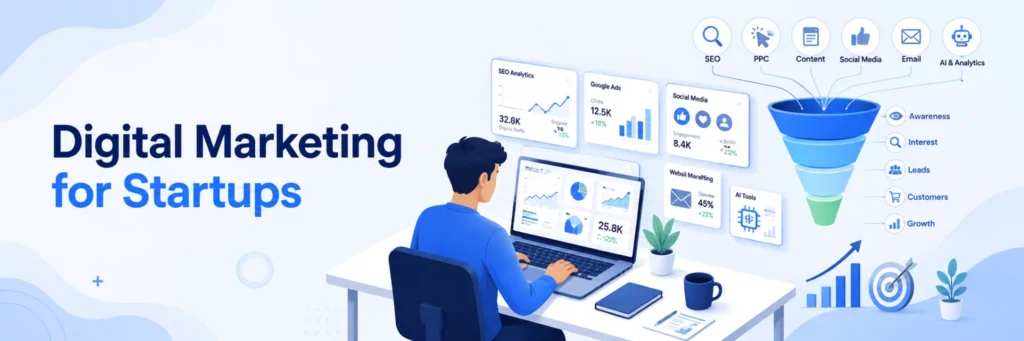
Launching a startup is exciting, but attracting your first customers is often the biggest challenge. A great product or service alone isn’t enough—you need a marketing strategy that reaches the right audience, builds trust, and generates consistent leads.
That’s where digital marketing for startups becomes essential. Unlike traditional advertising, digital marketing allows startups to reach potential customers through search engines, social media, email, and paid advertising while tracking every campaign’s performance.
Whether you’re a first-time founder, a small business owner, or an entrepreneur working from a coworking space, this guide explains how digital marketing works, which channels deliver the best results, and how to build a practical strategy without overspending.
What is Digital Marketing for Startups?
Digital marketing is the process of promoting your business using online channels such as Google Search, social media platforms, websites, email marketing, and paid advertising to attract, engage, and convert potential customers.
For startups, digital marketing isn’t just about increasing website traffic—it’s about generating qualified leads, acquiring customers efficiently, and building a sustainable brand with measurable results.
Unlike traditional marketing, every campaign can be monitored using analytics, allowing startups to understand what works, optimize spending, and improve return on investment (ROI).
Why Digital Marketing Is Important for Startups
Startups often have limited budgets, making every marketing decision important. Digital marketing provides a cost-effective way to compete with larger businesses while reaching customers at different stages of their buying journey.
Key Benefits
- Generate qualified leads without relying only on referrals
- Increase brand awareness among your target audience
- Measure campaign performance with real-time data
- Reach local, national, or global customers
- Build long-term organic traffic through SEO
- Scale marketing campaigns as your business grows
For example, a startup offering B2B software may use SEO to attract organic traffic, Google Ads to generate immediate leads, LinkedIn to connect with decision-makers, and email marketing to nurture prospects into paying customers.
Best Digital Marketing Channels for Startups
Not every marketing channel delivers the same results. The right choice depends on your business goals, budget, and target audience.
Channel |
Best For |
Time to Results |
Investment |
|---|---|---|---|
| SEO | Long-term organic growth | 3–6 months | Low to Medium |
| Google Ads | Immediate lead generation | Immediate | Medium to High |
| Content Marketing | Building authority | 3–6 months | Low |
| Social Media | Brand awareness & engagement | 1–3 months | Low |
| Email Marketing | Customer retention | Immediate | Low |
| Video Marketing | Product education & trust | 2–4 months | Medium |
Instead of trying every platform, startups should focus on two or three channels that best match their audience and objectives.
7 Best Digital Marketing Channels in 2026 (and How to Use Them Effectively)
SEO vs Google Ads: Which Is Better?
One of the most common questions startup founders ask is whether they should invest in SEO or Google Ads.
The answer depends on your goals.
Choose SEO if you want:
- Long-term organic traffic
- Lower customer acquisition costs over time
- Strong brand authority
- Sustainable lead generation
Choose Google Ads if you need:
- Immediate website traffic
- Fast lead generation
- Product launches
- Time-sensitive campaigns
For most startups, a combination of both works best. Google Ads can generate quick leads while SEO builds long-term visibility and reduces dependency on paid advertising.
Build a Simple Startup Marketing Funnel
Successful startups don’t focus only on generating traffic—they build a marketing funnel that guides potential customers from awareness to purchase.
A simple startup marketing funnel includes:
Awareness → Interest → Consideration → Lead → Customer → Repeat Customer
Each stage requires different content and marketing channels. Blog articles and social media posts create awareness, while email campaigns, case studies, and product demonstrations help convert prospects into customers.
AI Tools Every Startup Should Use
Artificial intelligence has transformed digital marketing by helping startups automate repetitive tasks, create content faster, and analyze customer data more efficiently. However, AI should support your strategy—not replace human creativity and decision-making.
Here are some useful AI-powered tools for startups:
Tool |
Best Use |
|---|---|
| ChatGPT | Content creation, brainstorming, customer support |
| Google Gemini | Research and content planning |
| Canva AI | Social media graphics and presentations |
| Grammarly | Grammar, tone, and writing improvements |
| Google Analytics 4 | Website traffic and user behavior |
| Google Search Console | SEO performance and keyword insights |
Using these tools wisely can save time while improving the quality and consistency of your marketing efforts.
Top Mistakes to Avoid When Starting a Business
Common Digital Marketing Mistakes Startups Make
Many startups invest in marketing but fail to achieve results because they overlook the fundamentals. Avoiding these common mistakes can save both time and budget.
❌ Ignoring SEO
Without SEO, your website relies entirely on paid advertising for traffic.
❌ Running Ads Without Tracking
Always set up Google Analytics 4 and conversion tracking before launching campaigns.
❌ Targeting Everyone
Define a clear target audience instead of trying to reach everyone.
❌ Inconsistent Content
Publishing one blog every few months or posting randomly on social media rarely delivers sustainable growth.
❌ No Landing Pages
Sending ad traffic to a homepage instead of a dedicated landing page often reduces conversions.
❌ Chasing Vanity Metrics
Focus on leads, conversions, and revenue rather than likes and followers alone.
Startup Challenges and How to Overcome Them
How Much Should a Startup Spend on Digital Marketing?
There isn’t a one-size-fits-all budget. The right investment depends on your industry, competition, and business stage.
As a starting point:
- Early-stage startups: Prioritize SEO, content marketing, and Google Business Profile.
- Growth-stage startups: Combine SEO with Google Ads and LinkedIn or Meta Ads.
- Established businesses: Invest in a balanced mix of organic and paid marketing while continuously optimizing campaigns.
The key is to measure performance regularly and allocate more budget to channels that consistently generate qualified leads.
Managed Office vs Traditional Office
Key Metrics Every Startup Should Track
Successful marketing decisions are driven by data. Instead of tracking dozens of metrics, focus on the ones that directly impact business growth.
Essential KPIs
- Organic Website Traffic
- Qualified Leads
- Conversion Rate
- Cost Per Lead (CPL)
- Customer Acquisition Cost (CAC)
- Return on Ad Spend (ROAS)
- Click-Through Rate (CTR)
- Email Open Rate
- Returning Visitors
Review these metrics monthly to identify what’s working and where improvements are needed.
Frequently Asked Questions
What is digital marketing for startups?
Digital marketing helps startups promote their products or services online using channels such as SEO, Google Ads, social media, content marketing, and email marketing to generate leads and grow their business.
Which digital marketing channel is best for startups?
There isn’t a single best channel. Most startups benefit from combining SEO for long-term growth with Google Ads for immediate visibility.
How long does SEO take to show results?
SEO typically takes 3–6 months to deliver noticeable improvements, depending on competition, website quality, and content consistency.
Should startups invest in Google Ads?
Yes, especially when quick lead generation is important. However, paid advertising should complement—not replace—a long-term SEO strategy.
Is social media enough for business growth?
No. Social media is effective for engagement and brand awareness, but combining it with SEO, content marketing, and email marketing creates a stronger digital marketing strategy.
How to Choose the Right Coworking Space
Expert Tips for Startup Growth
- Focus on one or two marketing channels before expanding.
- Publish helpful, original content that answers customer questions.
- Track campaign performance using Google Analytics and Search Console.
- Build an email list from day one to nurture potential customers.
- Review your marketing strategy every month and optimize based on data.
Conclusion
Digital marketing is one of the most effective ways for startups to build brand awareness, generate qualified leads, and achieve sustainable growth. Instead of trying every marketing channel, focus on strategies that align with your business goals, budget, and audience.
A combination of SEO, valuable content, Google Ads, social media, and data-driven decision-making can help startups compete effectively, even in highly competitive markets. By staying consistent, measuring results, and adapting to changing customer behavior, your startup can build a strong online presence and grow with confidence.