Managed Office Space vs Traditional Office: Which is Better
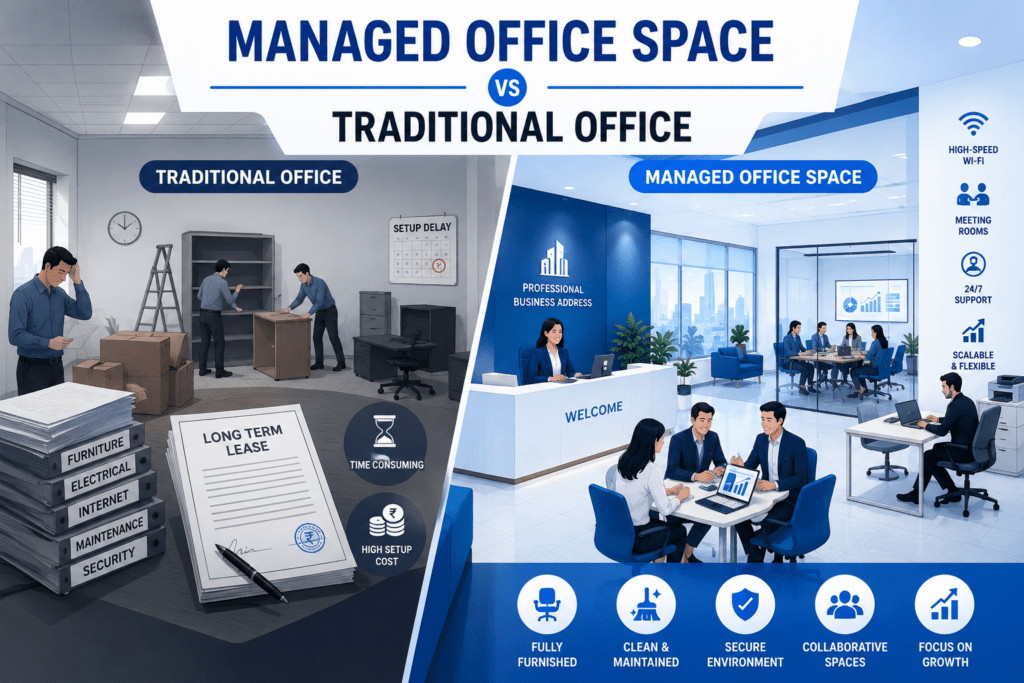
Managed Office Space vs Traditional Office: Which Is Better for Your Business?
Choosing the right office is one of the most important decisions for any business. Whether you’re launching a startup, expanding your team, or relocating your company, your workspace directly affects productivity, employee satisfaction, operational costs, and future growth.
For decades, businesses relied on traditional office leases. While they still work for some organizations, today’s companies increasingly prefer a managed office space because it offers flexibility, predictable costs, and a ready-to-move-in work environment. Instead of spending weeks setting up furniture, internet, utilities, and maintenance services, businesses can begin operations almost immediately.
If you’re evaluating different workspace options, you may also find our guide on 7 Signs Your Business Needs a Coworking Space helpful in understanding which office model best suits your stage of growth.
In this guide, we’ll compare managed office space vs traditional office, explain their key differences, discuss the advantages of each, and help you decide which option is the better investment for your business in 2026.
What is a Managed Office Space?
A managed office space is a fully furnished, professionally operated office that allows businesses to move in and start working immediately. Unlike a conventional office lease, the workspace is already equipped with everything needed for daily operations, including office furniture, high-speed internet, meeting rooms, reception services, housekeeping, power backup, and facility management.
Businesses pay a predictable monthly fee, eliminating the need to coordinate multiple vendors or invest in expensive office infrastructure.
Managed office spaces are especially popular among:
- Startups
- Small and medium-sized businesses (SMEs)
- Remote and hybrid teams
- Branch offices
- Project-based teams
- Growing enterprises
One of the biggest advantages is scalability. As your business grows, you can easily add more workstations or upgrade to a larger office without relocating or investing in additional infrastructure.
If you’re comparing different workspace options, you may also like our guide on How to Choose the Right Coworking Space, where we explain the factors businesses should evaluate before selecting an office.
What is a Traditional Office?
A traditional office is a leased commercial space where the business is responsible for setting up and managing the entire workplace.
This usually includes:
- Purchasing office furniture
- Installing internet connections
- Managing electricity and utility bills
- Hiring housekeeping staff
- Coordinating maintenance
- Setting up security systems
- Designing the office layout
Although traditional offices offer greater control over branding and customization, they also require a significant investment of time, money, and administrative effort before employees can start working.
For large organizations with stable long-term requirements, this model may still be suitable. However, for growing businesses that need flexibility, it often becomes expensive and difficult to scale.
Managed Office Space vs Traditional Office
Before making a decision, it’s important to understand how these two office models compare.
Feature |
Managed Office Space |
Traditional Office |
|---|---|---|
| Office Setup | Ready to move in | Requires complete setup |
| Furniture | Included | Purchased separately |
| Internet & Utilities | Included | Managed separately |
| Maintenance | Provider-managed | Business-managed |
| Lease Flexibility | Flexible | Usually long-term |
| Upfront Investment | Low | High |
| Expansion | Easy | Often requires relocation |
| Move-in Time | 1–2 days | Several weeks or months |
For most startups and growing businesses, a managed office significantly reduces operational complexity while providing access to premium infrastructure from day one.
Why Businesses Are Choosing Managed Office Spaces
The demand for managed office space has increased significantly over the last few years. Businesses are no longer looking for just an office—they’re looking for flexibility, convenience, and operational efficiency.
Here are the biggest reasons companies are making the switch.
1. Lower Setup Costs
Setting up a traditional office involves several upfront expenses, including furniture, workstations, internet installation, electrical work, meeting rooms, and office interiors.
A managed office eliminates most of these costs.
Everything is already in place, allowing businesses to start operations immediately while preserving capital for hiring, marketing, or business expansion.
This makes managed offices particularly attractive for startups and SMEs working with limited budgets.
2. Faster Business Operations
Time is valuable for every business.
Waiting several weeks to set up a new office can delay hiring, onboarding, and client meetings.
A managed office allows teams to move in almost immediately, reducing downtime and enabling businesses to focus on growth instead of office setup.
For startups participating in accelerator programs or expanding rapidly, this flexibility can be a major competitive advantage.
3. Predictable Monthly Expenses
One of the biggest challenges with traditional offices is managing multiple operational costs.
Businesses often pay separately for:
- Electricity
- Internet
- Cleaning
- Maintenance
- Security
- Reception
- Office management
A managed office combines these services into one monthly payment, making budgeting easier and helping businesses avoid unexpected operational expenses.
Growing companies often benefit from reducing overhead costs while maintaining a professional workplace. We discuss similar cost-saving strategies in our guide on Startup Challenges and How to Overcome Them, where efficient resource management is one of the key factors for sustainable growth.
4. Flexible Lease Terms
One of the biggest drawbacks of a traditional office is the long-term lease commitment. Businesses often have to sign contracts for several years, even when their future space requirements are uncertain.
A managed office space offers much greater flexibility. Whether you need an office for six months, one year, or a growing team, you can choose a plan that fits your business without being tied to lengthy contracts.
This flexibility is particularly valuable for:
- Startups
- Growing SMEs
- Project-based teams
- Companies opening satellite offices
- Businesses expanding into new cities
Instead of worrying about lease renewals or relocating every time your team grows, managed offices allow you to scale your workspace with minimal disruption.
5. Easy Scalability
Business needs change quickly. A startup with five employees today could become a team of twenty within a year.
With a traditional office, expanding usually means finding a larger property, negotiating a new lease, and investing in additional infrastructure.
A managed office space makes scaling much simpler. Most providers allow businesses to upgrade from dedicated desks to private cabins or larger managed offices without changing locations.
For founders preparing to grow, this flexibility saves both time and operational costs.
If your business is entering a growth phase, you may also enjoy reading our guide on Best Startup Accelerator Programs in India, where we explain how startups can scale faster with the right ecosystem and mentorship.
6. Better Employee Experience
Today’s employees expect more than just a desk and chair. A well-designed workplace improves productivity, collaboration, and job satisfaction.
Modern managed offices typically include:
- High-speed internet
- Ergonomic furniture
- Air-conditioned workspaces
- Meeting and conference rooms
- Breakout zones
- Pantry facilities
- Reception services
- Housekeeping
- Power backup
- CCTV security
These facilities create a comfortable and professional work environment, helping businesses attract and retain talented employees.
A better workplace also leaves a positive impression on clients and business partners.
7. Reduced Administrative Work
Managing an office takes time.
Business owners often find themselves dealing with internet providers, electricians, maintenance vendors, cleaning staff, and utility bills instead of focusing on growth.
A managed office provider handles these responsibilities, allowing your team to concentrate on core business activities.
This means less operational stress and more time for strategy, customer acquisition, and business development.
Who Should Choose a Managed Office Space?
A managed office space isn’t just for startups. It works well for businesses of all sizes looking for flexibility and operational efficiency.
It is an excellent choice for:
🚀 Startups
Reduce setup costs, preserve capital, and move into a professional office without long-term commitments.
📈 Small & Medium Businesses (SMEs)
Scale your office as your team grows while avoiding unnecessary infrastructure investments.
🌍 Remote & Hybrid Teams
Provide employees with a collaborative workspace whenever they need to work together.
🏢 Enterprises
Open regional offices quickly without managing multiple vendors or administrative tasks.
If you’re still evaluating workspace options, our guide on 7 Signs Your Business Needs a Coworking Space can help you decide whether a managed office is the right fit for your business.
Managed Office Space Decision Checklist
Before renting an office, ask yourself these questions:
- ✅ Does my business need flexibility to expand?
- ✅ Do I want to avoid large setup costs?
- ✅ Will I need meeting rooms regularly?
- ✅ Is metro connectivity important for my team?
- ✅ Do I want predictable monthly expenses?
- ✅ Would outsourcing office management save my team valuable time?
If your answer is “Yes” to most of these questions, a managed office space is likely the better choice over a traditional office.
Why Businesses Choose CO-OFFIZ
At CO-OFFIZ, we understand that every business has unique workspace requirements. That’s why we offer fully managed office spaces designed for startups, SMEs, and enterprise teams looking for flexibility, convenience, and a professional work environment.
Our managed office solutions include:
- Fully furnished private offices
- Dedicated cabins (1–100+ seats)
- High-speed Wi-Fi
- Meeting and conference rooms
- Reception and visitor management
- Pantry facilities
- Housekeeping and maintenance
- 24×7 power backup and CCTV security
- Flexible lease options
- Professional business addresses
Our centers are conveniently located at:
Whether you’re launching a startup, expanding your operations, or opening a new branch office, CO-OFFIZ provides workspaces that grow with your business.
Frequently Asked Questions
What is a managed office space?
A managed office space is a fully furnished, ready-to-use office where the provider manages infrastructure, maintenance, internet, utilities, housekeeping, and other operational services, allowing businesses to focus on their core activities.
Is a managed office better than a traditional office?
For many startups, SMEs, and growing businesses, yes. Managed offices offer lower setup costs, flexible lease terms, faster move-in, and reduced administrative responsibilities compared to traditional office spaces.
What is included in a managed office?
Most managed office spaces include furniture, high-speed internet, meeting rooms, reception services, pantry facilities, housekeeping, power backup, security, and maintenance.
Are managed office spaces suitable for startups?
Absolutely. Managed offices help startups reduce capital expenditure, scale quickly, and operate from a professional business environment without investing heavily in office infrastructure.
How is a managed office different from coworking?
A managed office provides a dedicated, private workspace customized for one company, while coworking spaces generally offer shared work areas where multiple businesses work together.
Final Thoughts
Choosing the right office isn’t just about finding a place to work—it’s about selecting a workspace that supports your business goals, team productivity, and future growth.
While traditional offices still suit some organizations, today’s businesses increasingly value flexibility, speed, and predictable operating costs. A managed office space eliminates the hassle of setting up and maintaining an office, allowing companies to focus on innovation, customer service, and expansion.
If you’re looking for a professional workspace that combines modern infrastructure with flexible office solutions, a managed office can be a smart long-term investment.
Suggested Internal Links
Naturally link to these related articles throughout your website: